














 It’s Only Common Sense: Hire for Hunger, Train for Skill
 Dan’s Biz Bookshelf: ‘The 'NVIDIA Way: Jensen Huang and the Making of a Tech Giant’





Improving Li-Ion Batteries by Coating Their Cathode
March 12, 2019 | Tokyo TechEstimated reading time: 3 minutes
Scientists at Tokyo Tech and Okayama University found a way of greatly improving the performance of LiCoO2 cathodes in Li-ion batteries by decorating them with BaTiO3 nanodots. Most importantly, they elucidated the mechanism behind the measured results, concluding that the BaTiO3 nanodots create a special interface through which Li ions can circulate easily, even at very high charge/discharge rates.
Three cathodes were fabricated: a standard bare one (left), one coated with a layer of BaTiO3 (middle), and one coated with several BaTiO3 nanodots (right). The one with the nanodots exhibited greatly enhanced performance.
It should be no surprise to anyone that batteries have enabled countless applications related to electric and electronic devices. Nowadays, modern advances in electrical devices and vehicles have created the need for even better batteries in terms of stability, rechargeability, and charging speeds. While Li-ion batteries (LIBs) have proven to be very useful, it is not possible to charge them quickly enough with high currents without running into problems such as sudden decreases in cyclability and output capacity owing to their intrinsic high resistance and unwanted side reactions.
Figure 1. Fabricated LiCoO2 cathodes.
The negative effects of such unwanted reactions hinder LIBs using LiCoO2 (LCO) as a cathode material. One of them involves the dissolution of Co4+ ions into the electrolyte solution of the battery during charge/discharge cycles. Another effect is the formation of a solid electrolyte interface between the active material and the electrode in these batteries, which hinders the movement of Li ions and thus degrades performance.
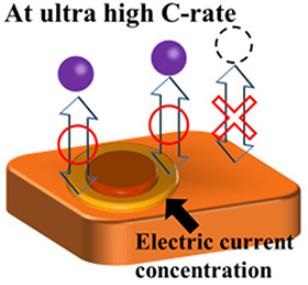
In a previous research, scientists reported that using materials with a high dielectric constant, such as BaTiO3 (BTO), enhanced the high-rate performance of LCO cathodes. However, the mechanism behind the observed improvements was unclear. To shed light on this promising approach, a team of scientists from Tokyo Tech, led by Prof. Mitsuru Itoh, Dr. Shintaro Yasui and Mr. Sou Yasuhara, studied LCO cathodes with BTO applied in different ways to find out what happened at the BTO–LCO interface in more detail.The team created three different LCO cathodes: a bare one, one coated with a layer of BTO, and one covered with BTO nanodots (Figure 1). The team also modeled an LCO cathode with a single BTO nanodot and predicted that, interestingly, the current density close to the edge of the BTO nanodot was very high. This particular area is called the triple phase interface (BTO–LCO–electrolyte), and its existence greatly enhanced the electrical performance of the cathode covered with microscopic BTO nanodots.
As expected, after testing and comparing the three cathodes they prepared, the team found that the one with a layer of BTO dots exhibited a much better performance, both in terms of stability and discharge capacity. “Our results clearly demonstrate that decorating with BTO nanodots plays an important role in improving cyclability and reducing resistance,” states Itoh. Realizing that the BTO dots had a crucial effect on the motility of Li ions in the cathode, the team looked for an explanation.
After examining their measurements results, the team concluded that BTO nanodots create paths through which Li ions can easily intercalate/de-intercalate, even at very high charge/discharge rates (Figure 2). This is so because the electric field concentrates around materials with a high dielectric constant. Moreover, the formation of a solid electrolyte interface is greatly suppressed near the triple phase interface, which would otherwise result in poor cyclability. “The mechanism by which the formation of a solid electrolyte interface is inhibited near the triple phase interface is still unclear,” remarks Itoh.
While still much research on this topic needs to be done, the results obtained by the team are promising and might hint at a new way of greatly improving LIBs. This could be a significant step for meeting the demands of modern and future devices.
Page 1 of 2
Share on:


Testimonial
"We’re proud to call I-Connect007 a trusted partner. Their innovative approach and industry insight made our podcast collaboration a success by connecting us with the right audience and delivering real results."
Julia McCaffrey - NCAB GroupSuggested Items
Wire Harness Taking a Step in the Right Direction
04/08/2026 | Nolan Johnson, SMT007 MagazineTo fully understand the modernization of wire harness design and assembly, we met with members of the Innovation Advisory Team for the Wire Harness Manufacturer’s Association (WHMA) to outline the current challenges facing wire harnesses and the specific steps to implement a digital data flow from OEM to manufacturer and back. In some ways, the wire harness industry is moving from 19th-century to 21st-century technology. But in the meantime, the real challenge isn’t building the harness—manufacturers are very good at that.
Lockheed Martin Ships 2nd Aegis Vessel Set with AN/SPY-7 Radar to Japan
03/16/2026 | Lockheed MartinLockheed Martin, successfully delivered the second Aegis System Equipped Vessel (ASEV) shipset of AN/SPY-7(V)1 radar equipment to the Japan Ministry of Defense (JMOD).
Marcy’s Musings: Our Own March Madness
03/18/2026 | Marcy LaRont -- Column: Marcy's MusingsI spend a lot of time looking ahead, whether that's toward future technology, market needs, or even the future of my editorial calendar. The industry is looking ahead as well. Every year at APEX EXPO, for example, participants get a clearer look at where we’re headed over the next three to five years. In fact, as our March issue is published, we will be in the throes of another great show (our own version of March Madness).
From PEDC to APEX: Banyan.eco’s Disruptive AI for EMS and OEM Companies
03/17/2026 | Marcy LaRont, I-Connect007The electronics industry’s struggle with supply chain resilience and increasing regulatory complexity has created a costly compliance challenge for OEMs and EMS providers alike. At the same time, advances in artificial intelligence are opening new possibilities for automating some of the industry’s most data-intensive tasks. At the Pan-European Design Conference (PEDC), Banyan.eco cofounder Francis D’Souza introduced a new approach that combines AI-driven data acquisition with a deterministic verification layer to eliminate compliance risk from AI hallucination and dramatically improve productivity.
Insulectro Technology Village to Feature 30 Powerchats at APEX EXPO in Booth 4237
03/04/2026 | InsulectroInsulectro, the largest distributor of materials for use in the manufacture of PCBs and printed electronics, will present its popular and successful 13.5-minute PowerChats™ during this year’s IPC APEX EXPO at the Anaheim Convention Center, March 17-19, 2026.